Quick start
Install & Run
To quickly get started with BiaPy, follow these steps:
Step 1: Follow the installation instructions to set up BiaPy.
Step 2: Select the specific workflow you wish to use.
Step 3: Refer to the workflow-specific execution instructions found in the “How to run” section of each WORKFLOW CONFIGURATION page (located in the left-hand menu of this documentation), depending on the execution method you choose.
Find a visual guide of these steps below:
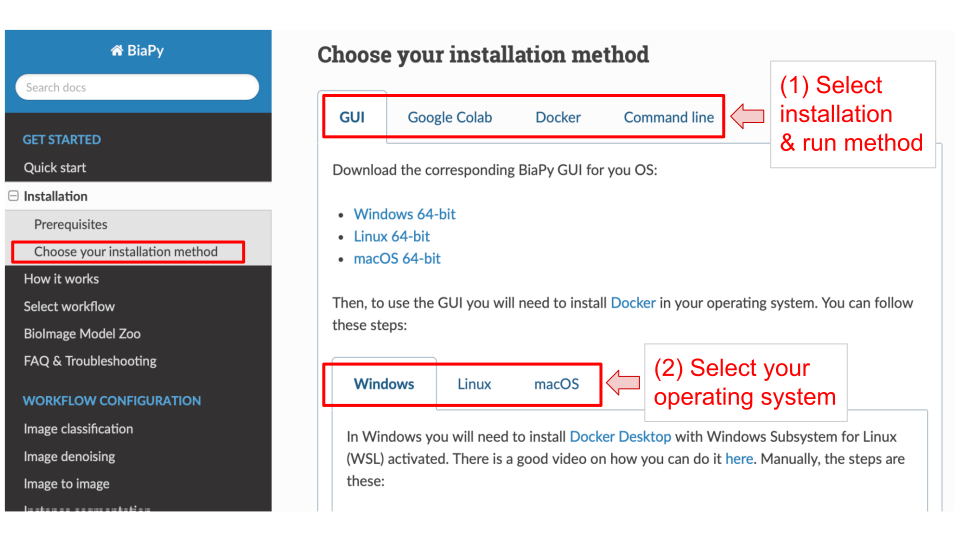
Step 1: Under GET STARTED > Installation > Choose your installation method, look for the option that best matches your expertise and operating system.
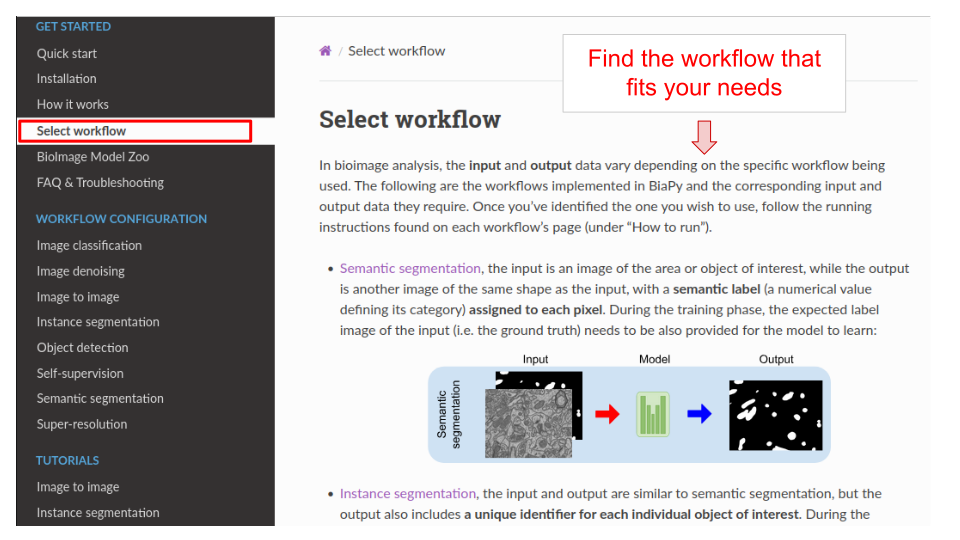
Step 2: Under GET STARTED > Select workflow, find the description of a workflow that best matches your task.
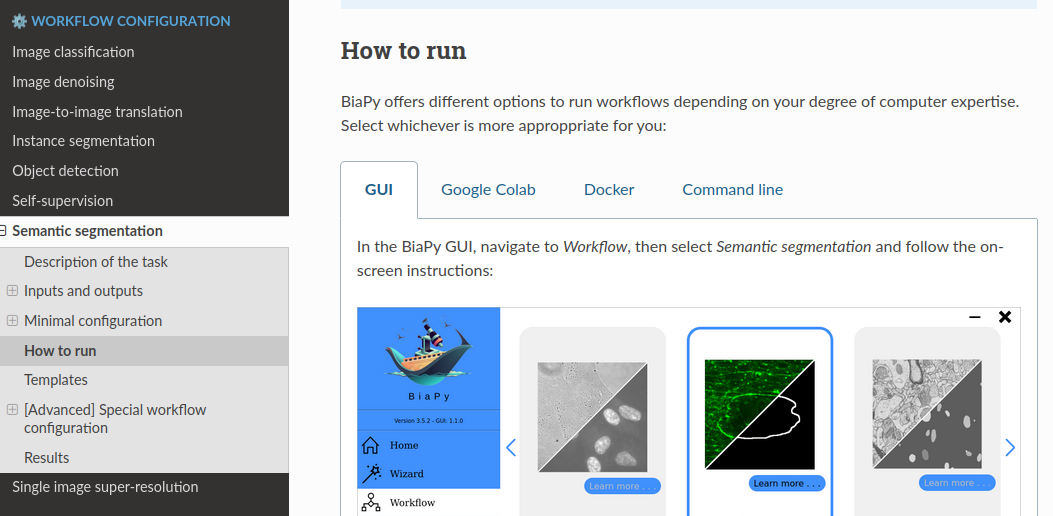
Step 3: Under WORKFLOW CONFIGURATION, click on the workflow you selected in the previous step and follow the instructions under "How to run".
Execution methods
BiaPy offers several execution methods, designed to accommodate a range of expertise levels, from beginner to advanced:
Graphical User Interface (GUI): A user-friendly, wizard-based interface ideal for beginners. Explore the main features in our quick GUI walkthrough video:
Note
The GUI shown in the video corresponds to an earlier version of BiaPy. The current interface may differ slightly in appearance and functionality.
Jupyter Code-free Notebooks in Google Colab: Run workflows either locally or directly in Google Colab. Learn more in our quick notebook walkthrough video:
BiaPy integration into the Galaxy project: Available as a dedicated tool within the Galaxy ecosystem.
Docker Containers: Provide portable, consistent, and fully reproducible environments using Docker.
Command-Line Interface (CLI): Designed for advanced users who prefer working directly with terminal commands.
BiaPy’s API: Enables advanced users to integrate BiaPy functionalities seamlessly into their own codebases.
Limitations
While BiaPy covers a wide range of tasks such as segmentation, object detection, and super-resolution, it does not include functionalities for common tasks like image visualization, registration, tracking, or manual annotation. For these tasks, we recommend using other popular tools in the bioimage analysis community.
For example, visualization is not natively supported in BiaPy. To address this, we have collaborated with the Brainglobe project, an open-source initiative focused on computational neuroanatomy. In this partnership, BiaPy handles large-scale image processing, such as brain-wide cell detection, while Brainglobe’s framework is used for visualizing and further analyzing the results.
A tutorial on how to integrate BiaPy with Brainglobe can be accessed here.
Moving forward, BiaPy will remain focused on deep learning tasks, relying on specialized platforms for complementary functions like visualization and registration.
Further information
For a more in-depth understanding of BiaPy functioning, visit the “How it works” and “Configuration” sections. Similarly, if you encounter any challenges while running BiaPy, please consult the FAQ & Troubleshooting section for assistance.
The TUTORIALS section is populated with detailed tutorials designed to replicate the tasks accomplished in all the projects where different BiaPy workflows have been employed.
To contribute or develop your own code based on BiaPy, please follow the guidelines on the “How to contribute” section.